The Map
See who talks to who
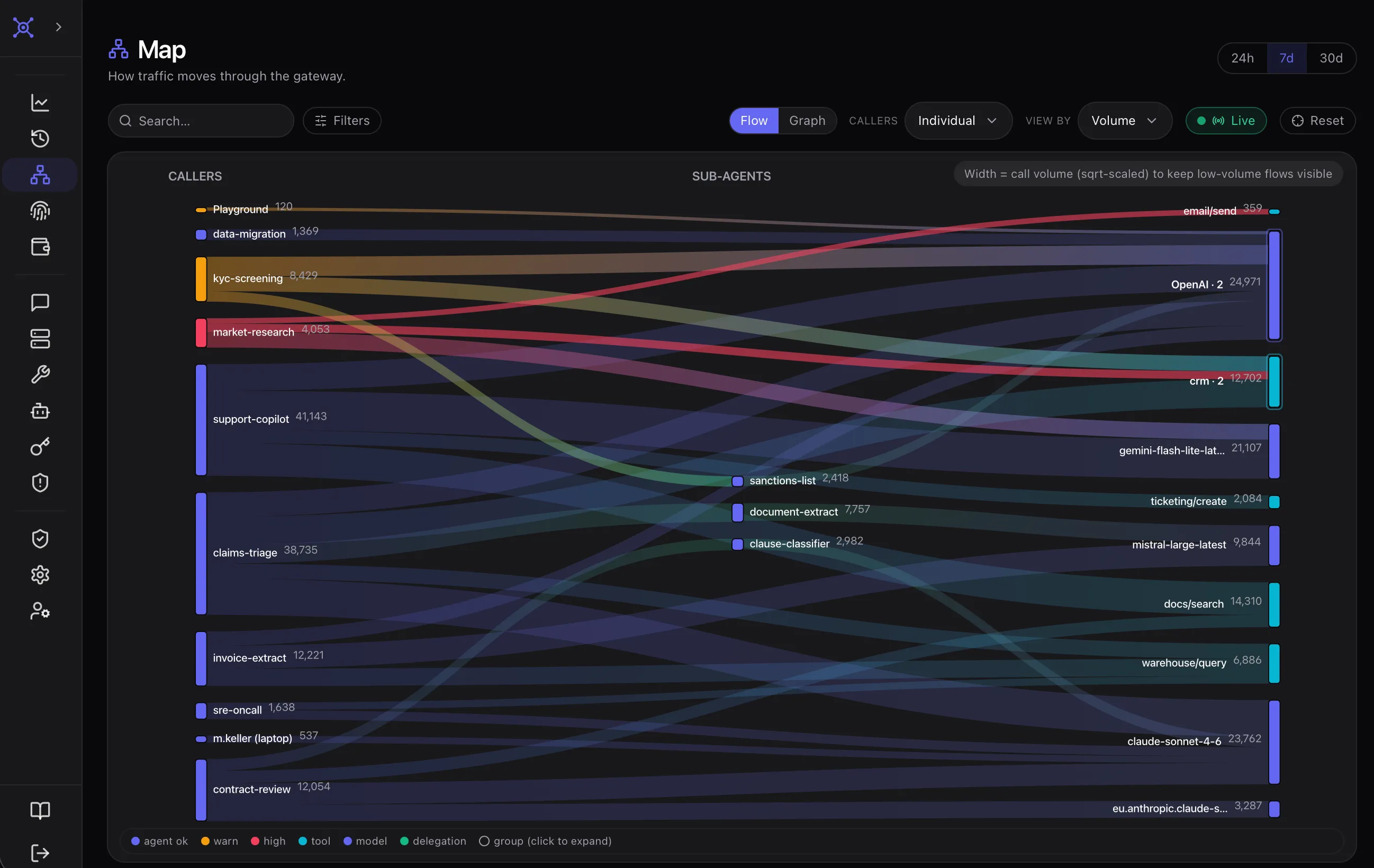
Every agent, sub-agent, tool and model your estate reaches, drawn from real traffic rather than a diagram someone kept up to date. Width is call volume. Red is what the gateway refused.
One OpenAI-compatible endpoint in front of every model, MCP tool, and agent your apps call. aigw caps the spend, enforces the policy, and keeps a tamper-evident audit. EU-hosted, on your own provider keys.
New to this? See how it works, a plain-language walkthrough →
No card. Keep your own provider contracts. Point your OpenAI client at the gateway and go.
Per-key budgets, policy, approvals, and a tamper-evident audit of every call.
Cut token spend with caching that reuses identical and repeated work. No quality loss.
EU-hosted. Your keys, your data, your region. Governance and audit for the EU AI Act.
Route, secure, observe, and control every model, tool, and agent call from one place.
Govern not just models, but the MCP tools and agents they hand work to.
See who talks to who, across your whole agent estate.
Scoped virtual keys per agent or workload, each traceable back to a real person.
A tamper-evident, hash-chained record of every action. Content logging is opt-in and redacted.
Per-key budgets, a lossless savings engine, and spend allocated back to whoever spent it.
EU-hosted, or run the data plane yourself. Prompts stay where you put them.
Automate it all as config with the management API, and keep your existing clients: the gateway is OpenAI-compatible.
Keep your own provider contracts and keys. Give every app and agent one endpoint, per-key budgets, and one audited view. Same SDK, same code.
Set base_url to your gateway and use a virtual key as the API key. Chat, streaming, and embeddings all work unchanged.
Add your OpenAI, Anthropic, or other provider keys once. Issue a virtual key per team, project, or agent, each with a monthly budget and an allow-list of models.
The console shows spend, p95 latency, cache-hit and error rates per model, plus a tamper-evident audit of every request.
from openai import OpenAI

client = OpenAI(
    base_url="https://gateway.aigw.app/v1",
    api_key="aigw_…",     # a virtual key with a budget
)

# Same code, any provider - just change the model string.
resp = client.chat.completions.create(
    model="claude-sonnet-4-6",
    messages=[{"role": "user", "content": "Summarize Q3 in one line."}],
)
print(resp.choices[0].message.content)Every agent, sub-agent, tool and model your estate reaches, drawn from real traffic rather than a diagram someone kept up to date. Width is call volume. Red is what the gateway refused.
Cap spend per team, project, or agent. Screen prompts, tool results, and agent responses for PII and secrets before they leave the gateway. Keep a tamper-evident record of every call, tool use, and delegation for compliance, without slowing anyone down.
Open the console →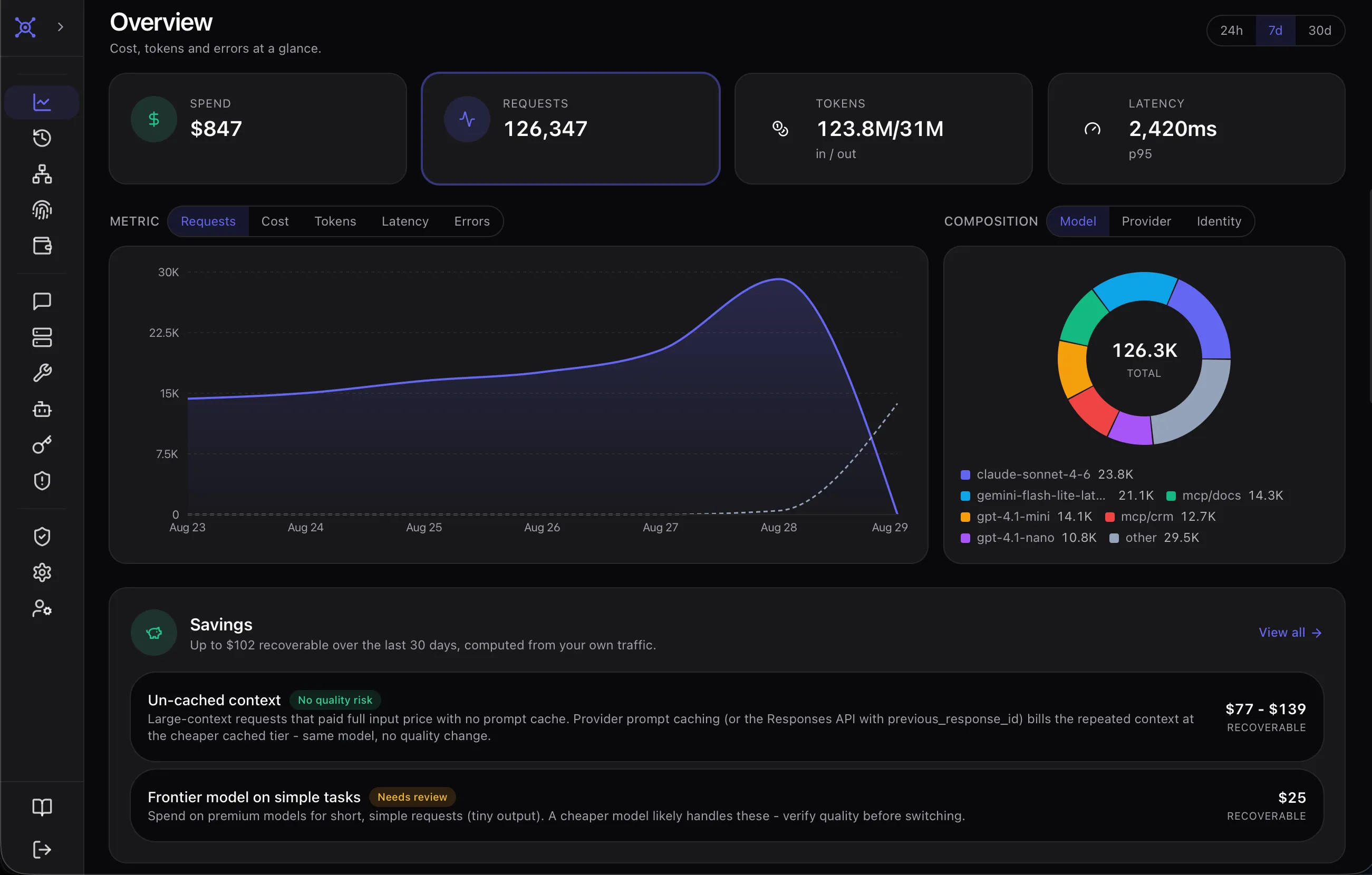
Routers serve the developer. Observability tools serve the platform team. AI gets governed only when engineering, security, and finance are reading the same record.
Ship on one endpoint and keep the SDK you already use.
Controls on what agents can do, and a record of what they did.
One number for AI spend, broken down by whoever spent it.
Automate all of it as config with the management API, and keep your existing clients: the gateway is OpenAI-compatible.
You keep your provider contracts and pay providers directly for inference. aigw charges a platform fee on top of that, quoted against how much spend you put through it and how you want it deployed.
We quote rather than publish while we onboard our first customers, and we would rather price against your real numbers than guess at them. Ask and you get a number, not a discovery call.
Point your SDK at the gateway and ship. The docs cover the quickstart, virtual keys and budgets, providers and models, and governance.
Point a slice of your traffic at the gateway in observe mode. It changes nothing about what your apps do, and it tells you what you are spending and where it is going.
One base URL change on one service. Recording only: no policy, no blocking, no redaction, nothing your users can feel.
Real spend attributed to models, teams, keys, and agents, plus which tools and agents your estate is actually reaching.
Waste we can remove with no quality risk, kept separate from savings that need a judgement call.
We reply from a real address, usually within a day. Nothing else lands in your inbox.
Not answered here? hello@aigw.app
Yes. Point any OpenAI SDK at your gateway base URL with a virtual key. /v1/chat/completions (incl. streaming), /v1/embeddings, and /v1/models all work. Anthropic and OpenAI-shaped providers are translated for you.
Yes. Add your OpenAI, Anthropic, or other provider keys on the Providers page. The gateway calls each provider with your keys, so you keep your own contracts, rates, and billing. aigw sits in front and governs the calls. There is no token reselling and no pooled billing.
Every virtual key carries a monthly budget in cents and a model allow-list, enforced at the edge in real time. You get one view of AI spend across every team, key, and agent, broken down by model and provider.
aigw is EU-hosted, so prompts and data stay in region. If that is not close enough, you can run the gateway yourself: self-hosted and hybrid deployments put the data plane in your own VPC or datacenter while the control plane stays managed. Bring your own provider keys; they are sealed at rest, and the gateway can spend a key but agents never see your raw provider secrets.
Redaction runs inside the gateway. On the model-output path it rewrites in a streaming-safe way: the provider and the audit log see placeholders, and your user sees the original text restored as the stream arrives. Tool and agent streams that cannot be scanned safely fail closed under redact or block, so nothing sensitive slips through.
You bring your own provider keys and pay providers directly for inference. aigw charges a platform fee on top for governance, the savings engine, observability, and EU hosting. The free tier is free, and paid plans are quoted against your governed spend and deployment, so start with an assessment and we will put a number to it.
Point a slice of your traffic at the gateway in observe mode. It records and attributes, and changes nothing about what your apps do. Within a couple of weeks you get your real AI spend broken down by model, team, and agent, plus the waste we can remove without touching output quality. You keep the report either way.
Yes. Self-hosted and hybrid gateways run the data plane in your own VPC or datacenter, so prompts never leave your network, while policy, audit, and the console stay in the managed control plane. Fully air-gapped deployments are quoted per environment.